Thermal analysis
Rotary-Drill Oil Cooler: Fin & Airflow Study
Compared fin geometry and airflow direction to improve oil-cooler heat rejection while accounting for pressure drop and fan requirements.
Team design challenge · EML4140 · Sandvik
My contribution
I evaluated rectangular, pin, and louvered fin concepts with MATLAB and ANSYS Fluent as part of the Sandvik team design study. I worked across the thermal and airflow comparisons, considering material selection, packaging, and the demands of a dusty mining environment.
Results & observations
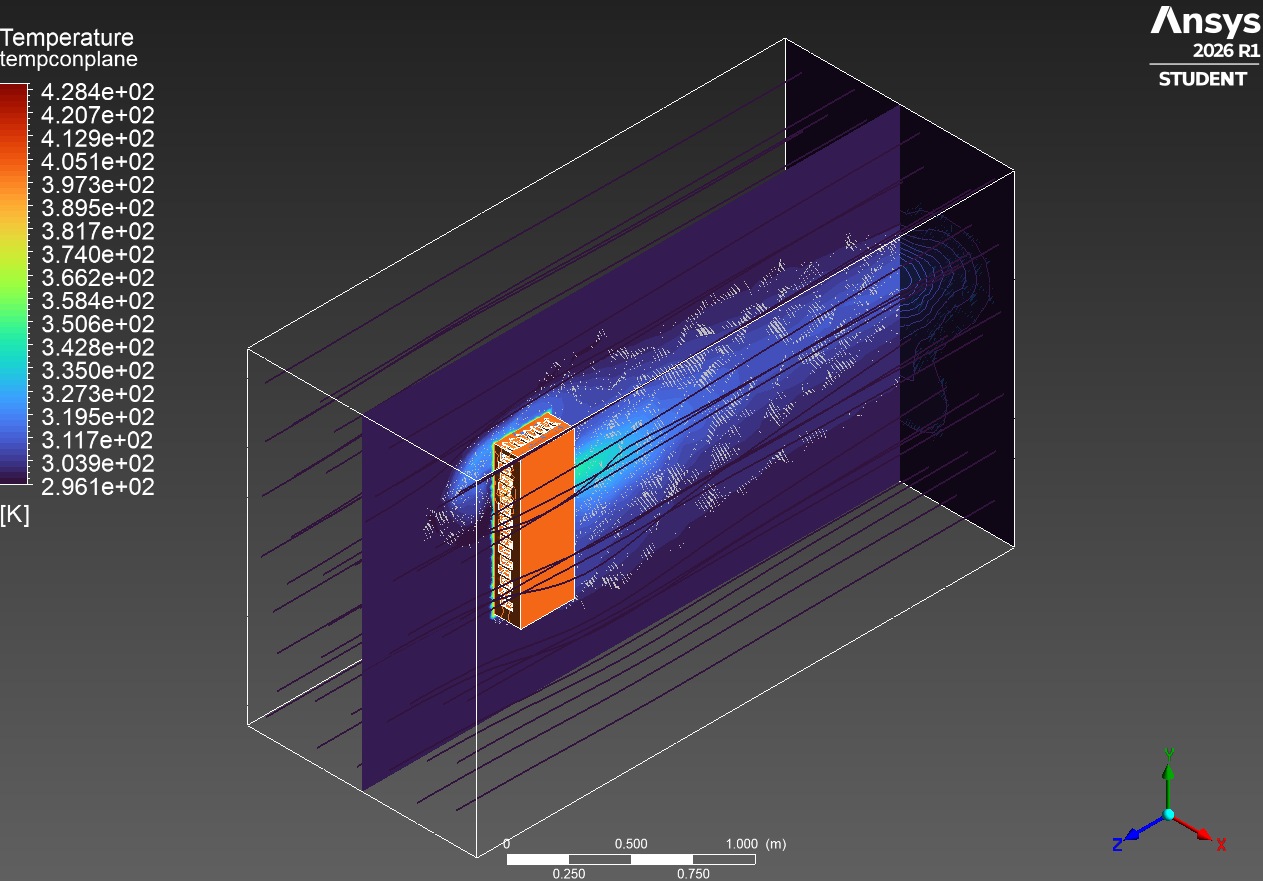
The modeled front-to-back airflow configuration transferred 13.2% more heat than the top-down configuration. The study favored that orientation and identified louvered fins for further investigation; full-core pressure-drop and fouling tests would be needed to validate the concept.
The design question
We investigated ways to increase heat rejection within the oil cooler’s fan, packaging, and dusty-service constraints. The study compared rectangular, pin, and louvered fins, airflow direction, and material choice.
What the model can tell us
The airflow comparison favored the existing front-to-back direction. Louvered fins also looked promising, but the CFD used simplified geometry, steady flow, constant properties, and isothermal tube surfaces. These are concept comparisons, not measured improvements to a production cooler.
Working through the tradeoffs
The supporting MATLAB models compare rectangular, pin, and louvered fins, then estimate fan speed, power, and noise implications. A separate first-pass thermal-resistance model omits fan-curve behavior, pressure losses, and nonuniform flow.
The next useful test
A full-core model, pressure-drop validation, and dust-fouling tests would be needed before treating the concept as a production recommendation.
Tools & methods
- ANSYS Fluent
- MATLAB
- Heat transfer
- Fin geometry
- Pressure-drop analysis
- Thermal resistance
- Material selection
- Fan power estimates
- Design tradeoffs